The Palazzo Strozzi in Florence presented recently a large exhibition of Fra Angelico’s paintings. For a while, I thought about going there, but changed my mind. I had several times seen Fra Angelico’s frescoes in the monks' cells of the monastery of San Marco, also in Florence. Then I thought I should have taken the opportunity. Fra Angelico is worth a journey.
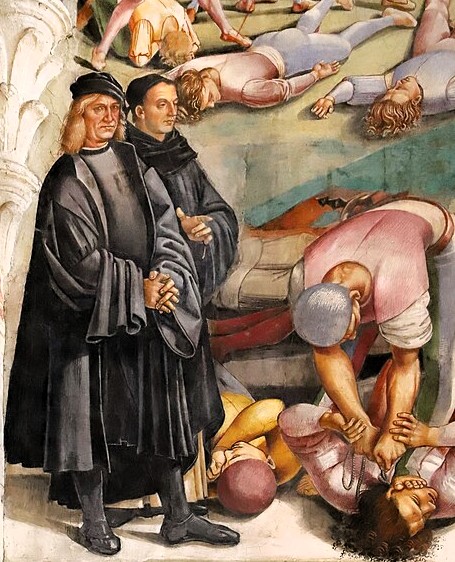
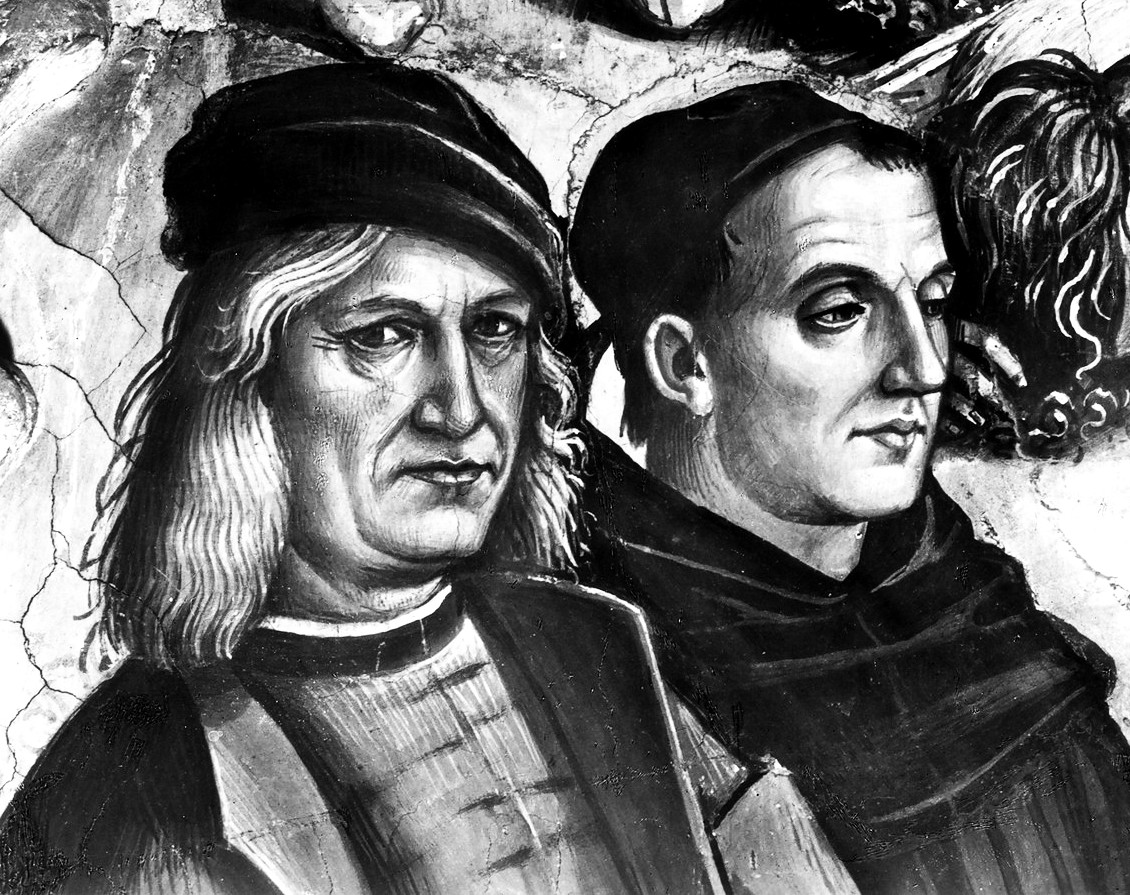
This discreet monk was not only one of the greatest painters of his time, which does not say little since Italy in those days constituted one of the pinnacles of world art. Furthermor, Fra Angelico was already then considered to be an immortal master. We see him in his colleague Luca Signorelli’s fresco in Orvieto, where the two of them contemplate the violence unleashed by Antichrist, a world potentate who, under false pretenses, would set the world on fire. We know him as Hitler or Stalin, or why not Putin, Trump and Netanyahu. In a corner of the fresco the two artists stand next to a man who puts his foot on a fellow human being’s head, while strangling him to death. The elder Signorelli, look at us with a tired face, the gentler and seemingly younger monk (he had nevertheless died forty-five years earlier) watches quite expressionlessly terrible massacre taking place around him, though with a discreet gesture it seems as if he wants to draw our attention to the unbridled mayhem raging in his vicinity.
Giorgio Vasari wrote seventy years later:
It is impossible to heap enough praise on this holy man, who was so humble and modest in all that he did and said, and whose images were created with such ease and so much piety.
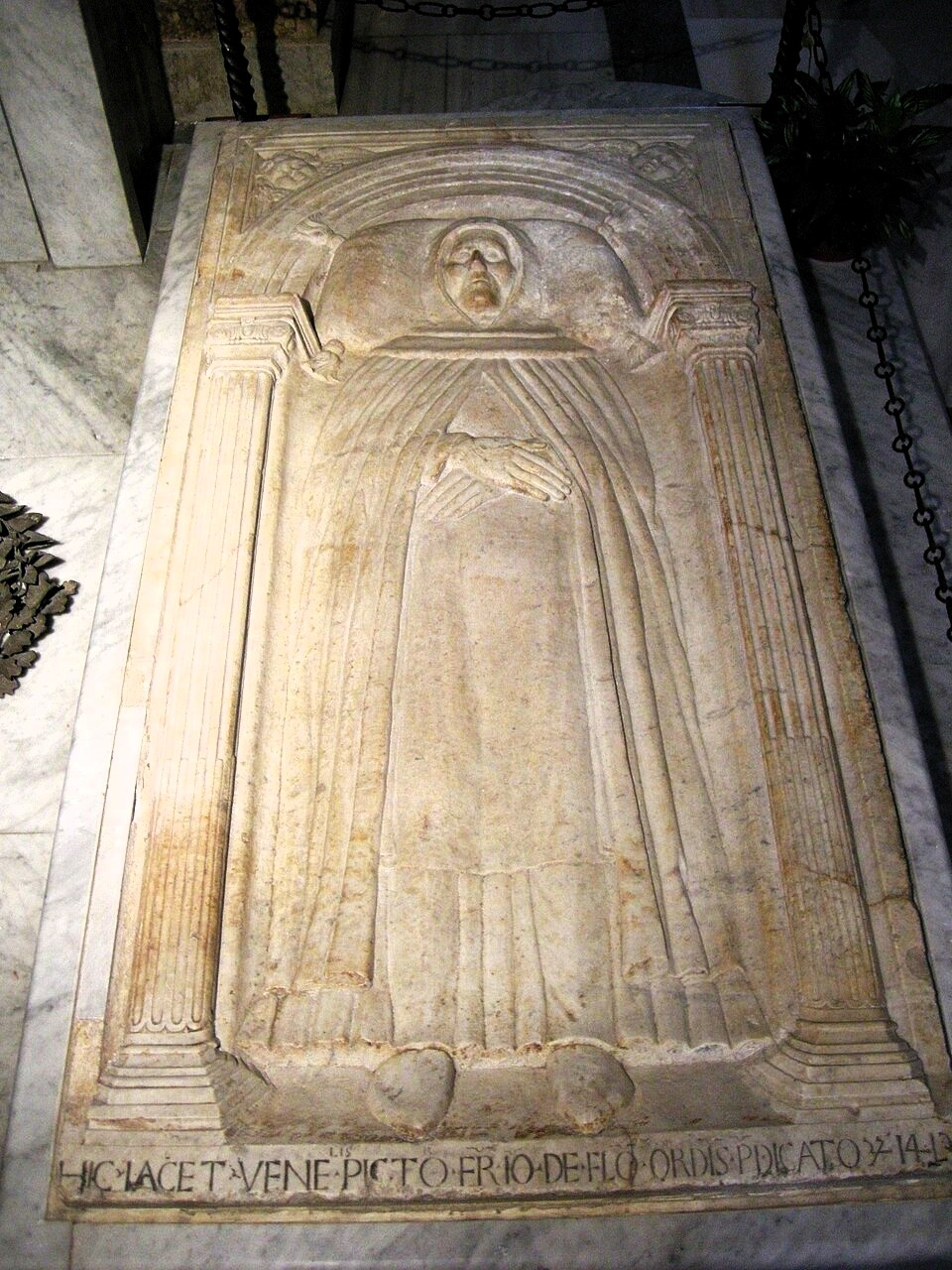
Fra Angelico’s sarcophagus is placed in the Basilica of Santa Maria sopra Minerva in Rome. At the feet of the figure adorning it, his students have carved the words:
In this place rests the glory, the mirror and the ornament of all artists, the Florentine Giovanni [that was his real name and he came from Fiesole, a small town just north of Florence]. A pious and true servant of God. He was a brother of the Order of St. Dominic. His disciples mourn the death of their great Master, for who will now be able to use a brush like his? His homeland and his order mourn the death of a great artist, he had no equivalent in his art.
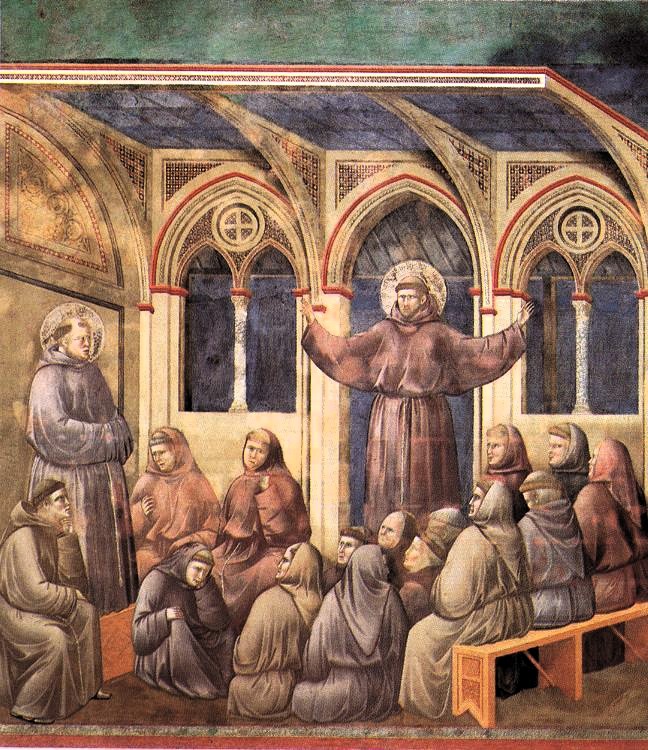
And of course, Fra Angelico was unique and, in many ways, quiet ahead of his time. I come to think of a small painting I once saw in Berlin, L'Apparizione di san Francesco su un carro di fuoco, The Apparition of Saint Francis on a chariot of fire. The painting is based on one of the many legends that emerged after Francis’ death and collected by his disciples. According to this story, the recently deceased Saint Francis appeared while Anthony of Padua was preaching to a crowd of monks in Arles, France. In the upper church in Assisi, in a fresco painted by Giotto, or his disciples, we see how St. Anthony suddenly falls silent while standing in front of the devoutly listening monks. Only he, and another monk at his side, can see the apparition in the entrance of the hall.
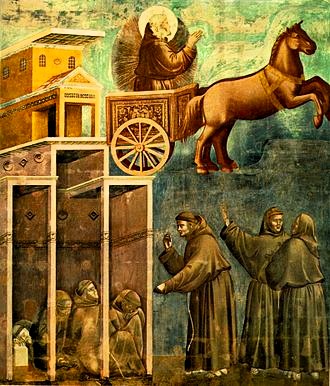
In the same series of pictures, Giotto described how another group of Franciscans, who exhausted after prayer and meditation had fallen asleep. Suddenly, they are woken up by a group of other brothers who have not been able to sleep and therefore been wandering around in the vicinity of the house. They have seen how Francis travelled towards heaven in a chariot ablaze with fire. The scene is depicted in a strange, undramatic way. We do not discern any flames, but St. Francis is surrounded by a mandorla, a large halo. It seems that Giotto wanted to transmit a feeling that it is not “real” event he had depicted, it was a vision. The unnaturally large chariot and its horses seem to stand still in the air, as if the sleeping brothers, a monk is in the process of waking them up, will have enough time to experience the marvellous sight before it disappears.
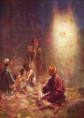
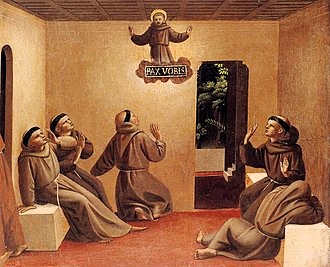
Now to Fra Angelico’s version of the same event, perhaps painted 140 years later. Its realism is astonishing. In the small painting, we see five monks in a bare room, opening onto a moonlit garden. One of them has fallen asleep while the others seem to be half awake and confused. One of them sits stretched out on his hard stone bench, as if he had sunk down during his sleep. He supports himself with one hand while he with the other in surprise and bewilderment is covering his face. Another of the monks has fallen to his knees and is looking up at a bright vision of St. Francis, who is not traveling in a chariot of fire, but in a diminutive form has appeared while being carried by a cloud on which is written “Peace be upon you.” This is undoubtedly a vision. But look at the astonishing skill with which Fra Angelico has depicted it all! How unexpectedly modern it all seems to be, with what originality the actions on this small stage are depicted.
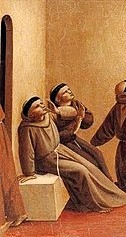
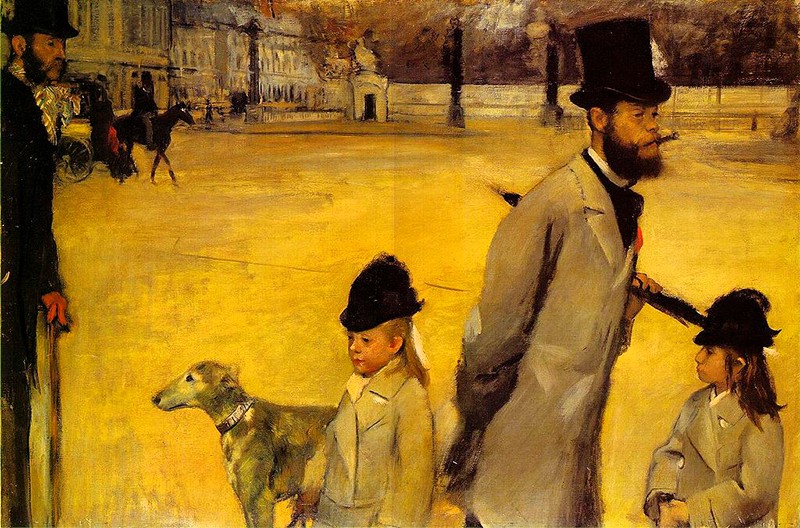
On the left, a monk has just left the room, unaware of the apparition. It would take hundreds of years before artists dared to crop the people of a picture surface in such a manner. It first became common with the invention of photography and is often encountered in paintings by an impressionist like Degas.
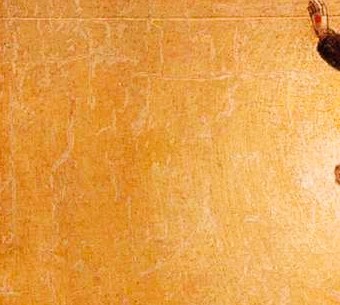
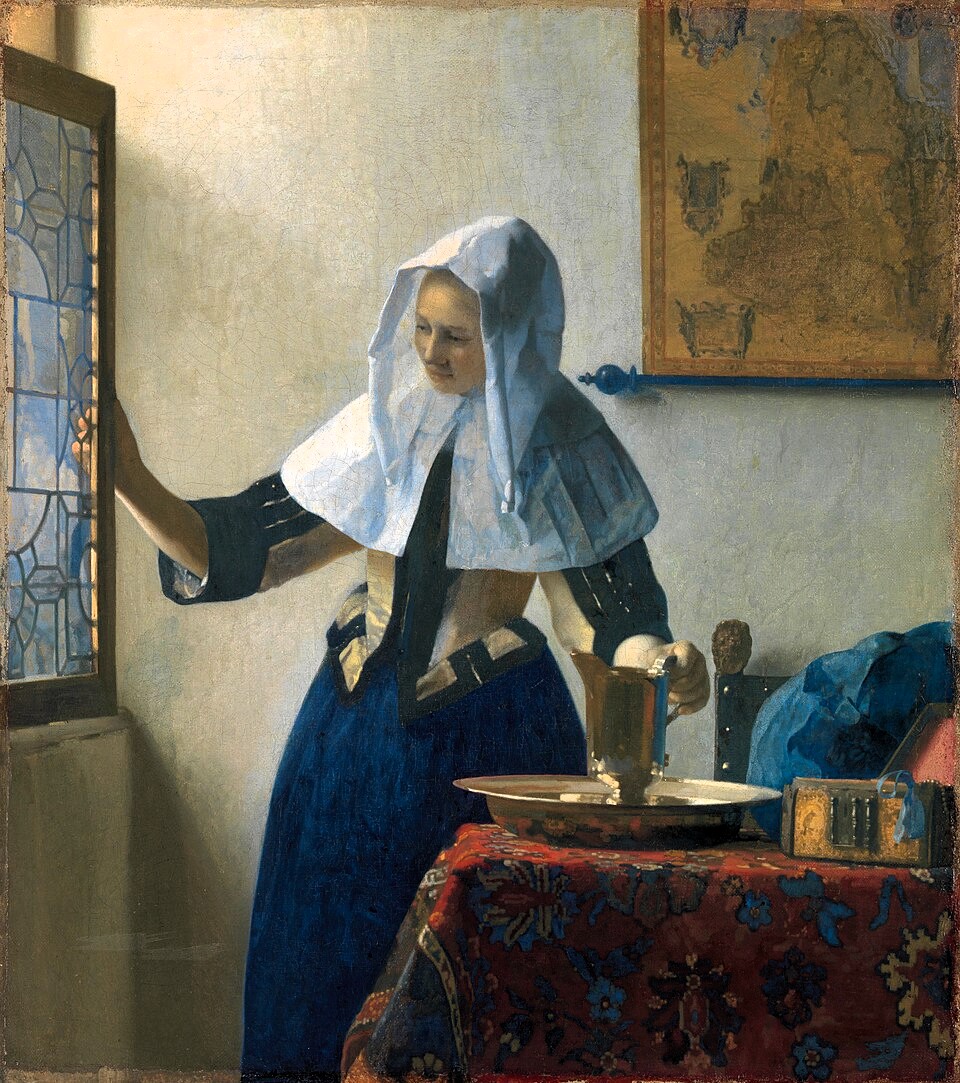
Or take the sophisticated play of light on the worn and bare wall in front of which Franciscus appears. Hundreds of years later, Vermeer van Delft was also able to bring a monochrome wall to life. Like him, Fra Angelgo was well aware of the fact that a wall painted with one colour shows a multitude of shades of light.
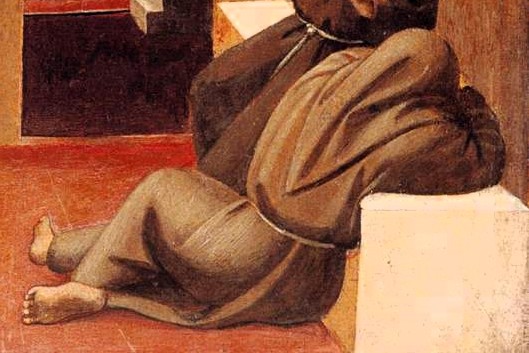
Every detail is exquisite. How skilfully foreshortened and perfectly natural is not the position of the sleeping monk?
The colour scheme is superb and made with great care, every detail observed with great expertise, like the entrance to the moonlit garden.
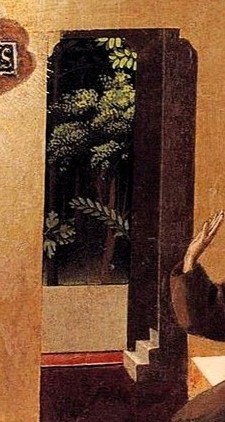
The small size of the picture is due to the fact that it was part of a predella, i.e. the series of smaller pictures that under an altarpiece often depicted the life of a saint or a biblical story. The paintings painted together with the vision of Franciscus have been broken off from an original altarpiece.
One of these paintings is now in the Lendenau Museum in Altenburg, Germany and depicts Francis’ meeting with the Sultan Malik al-Kamil. In 1219, Francis and a group of other monks had gone to Acre, the capital of the Latin kingdom of Jerusalem. The Fifth Crusade was in full swing, but after the Crusaders had captured the Egyptian port city of Damietta, there was a temporary ceasefire.
Francis did not support the Crusade. His intention was to use the truce to turn it into a pilgrimage. Upon his arrival in Acre, he went to the nearby Muslim camp and met the Muslim leader, Malik al-Kamil. His purpose was to discuss the Christian faith with the Sultan. Contrary to what the Christian war leaders feared, Francis was kindly met by the sultan, who carefully listened to him, but of course declined to be baptized as a Christian. However, he asked Francis to pray for him and they parted as friends.
Fra Angelico's picture depicts a legendary story that tells how Francis offered himself to walk through fire to prove his trust in God, on the condition that the Muslim imams accepted the challenge and did the same. When they hesitated, Francis refrained from his proposed fire walk.
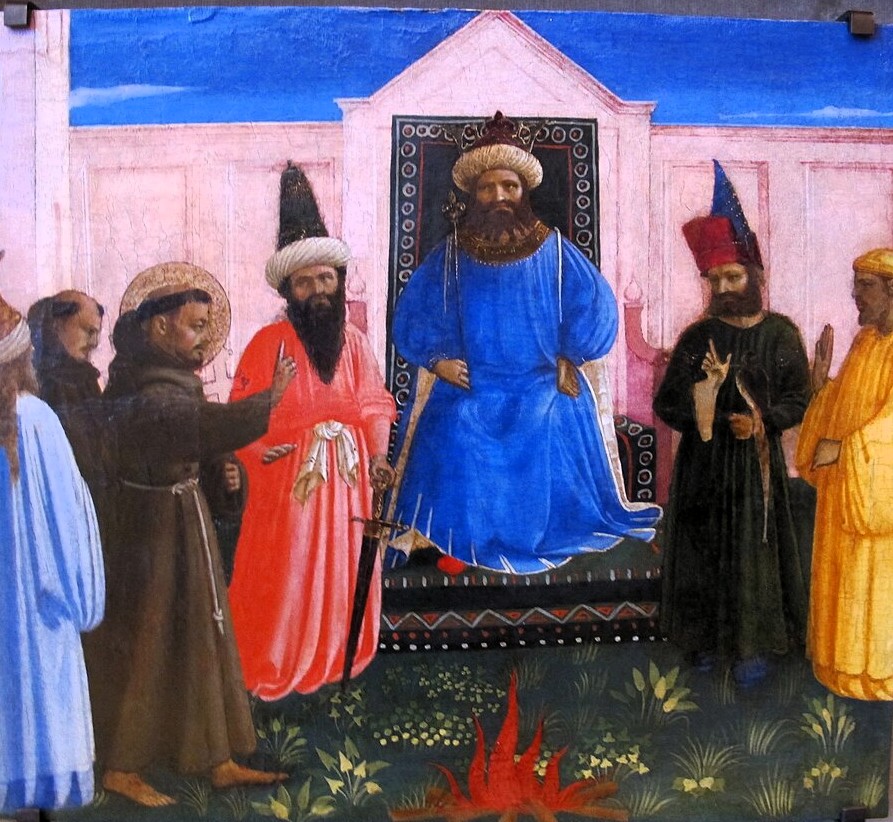
What characterises Fra Angelico's presentation is that it exudes the same undramatic calm as most of the other pictures. He points out the colourful robes of the Muslims that harmonize with each other in brilliant red, sky blue and saffron yellow. The plants are beautifully stylized and the fire is ridiculously small. All eyes are on St. Francis.
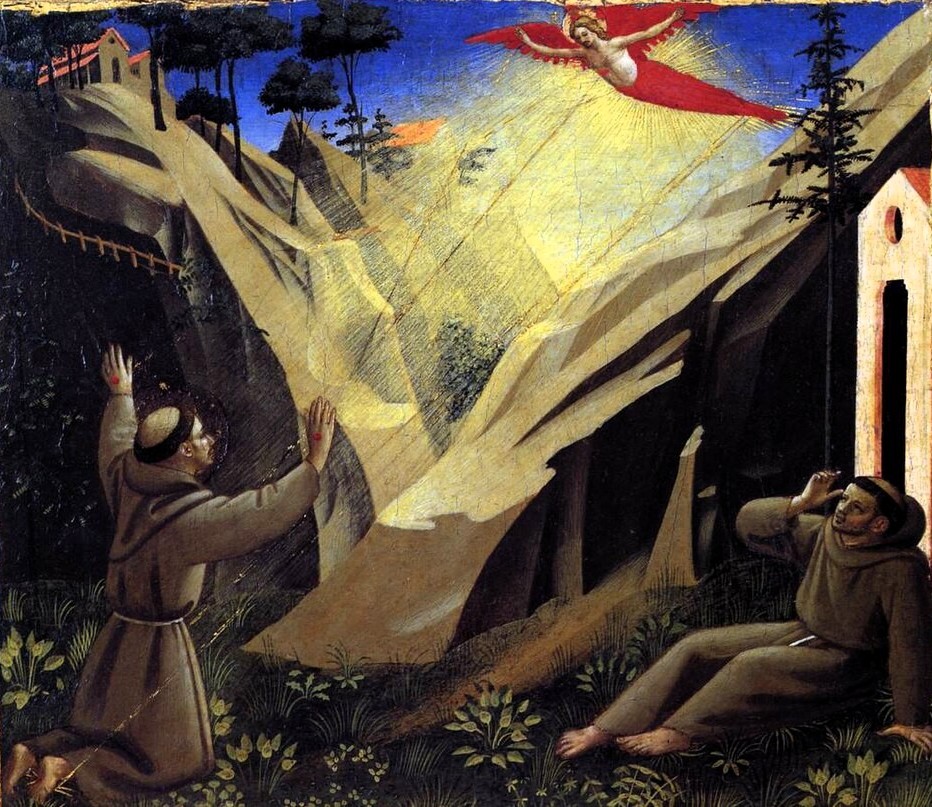
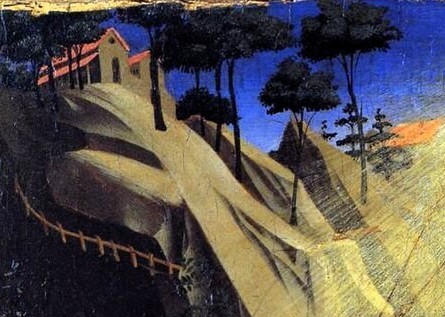
More dramatic is the depiction of how Francis received his stigmata from Jesus, who at dusk reveals himself as an angel with red wings. Rays from the wounds of his crucifixion shoot down in a river of light on the kneeling Francis. The light beams seem to split the landscape into a triangle pointing down towards the monk, who with uplifted hands calmly accepts his stigmata. His accompanying monk brother does not seem to be particularly upset either. The stylized landscape appears to be depicted in a manner that became popular among “realist” painters in the 1920s and 1930s.
Impressive are the pines that surround the abbey church, which in a bold perspective is depicted from below. The painting is now in the Vatican Museum.
St Francis’ sudden apparition to the monk friars in the bare room is, as mentioned above, to be found in Berlin's Gemäldegalerie, which also houses two more small paintings from the same predella. One of them depicts the meeting between St. Dominic and St. Francis, founders of the two Catholic orders of preachers. They meet at a church on a hill outside a fog-shrouded city. This may suggest that, as the Dominicans, but not the Franciscans, claimed that the two msaints met during the Fourth Lateran Council, convened 1215 in Rome by Pope Innocent III. As early as 1209, Francis had received the go-ahead from Innocent to form his order of beggars. It was not until 1216 that Pope Honorius III, after Innocentius’ death, recognized Dominic’s monastic order. The Franciscans generally claimed that it was in Assisi and not in Rome that Dominic met with Francis.
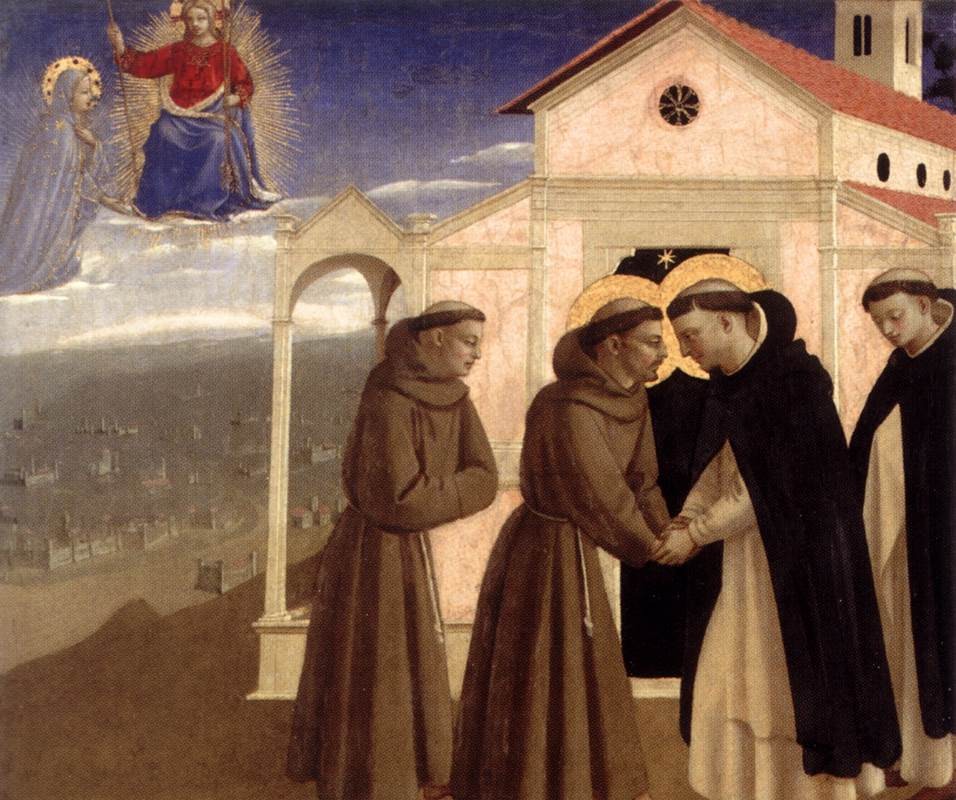
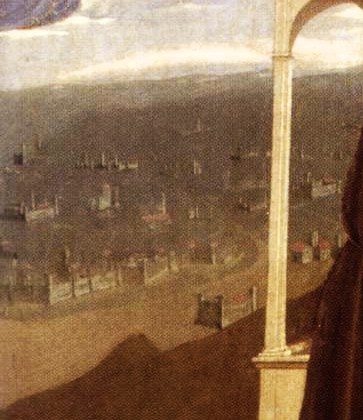
In Fra Angelico’s painting it seems as if they meet outside Rome and in Heaven we see how the Virgin Mary kneels before Christ asking him to help the two saints to save the world from its sins and halt the heretic onslaught. The presentation is characterized by the same kind of peace we find in so many other of Fra Angelico’s paintings. Interesting is his depiction of the distant big city, covered by a light fog.
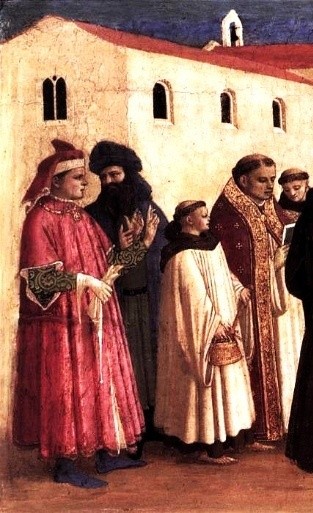
A more elongated depiction of St. Francis’ funeral was placed at the centre of the predella’s six pictures. This picture is also preserved in Berlin's Gemäldegalerie. The action takes place in a monastery yard among sadly restrained, brown-clad Franciscans, some of whom weep openly.
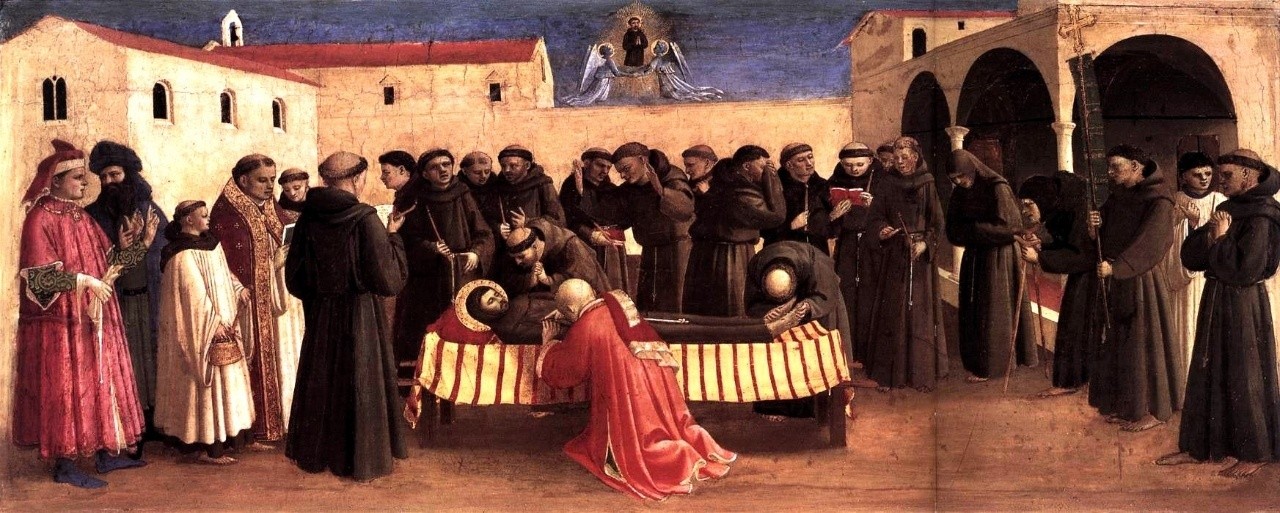
It is noteworthy that Fra Angelico has obviously made an effort to create a kind of group dynamics by making the monks move and look in different directions.
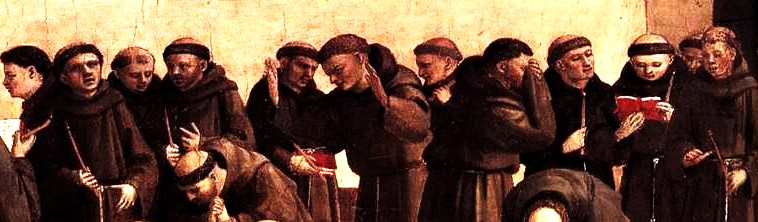
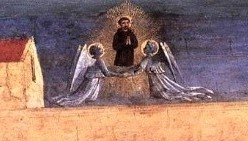
The brown colour of the monks is broken by the priests’ colourful robes and the red robe of a patrician who from the far left is observing the funeral rite. Meanwhile, far away in the background St. Francis is lifted up to Heaven by two white robed angels.
It has long been assumed that the six paintings were placed under a lost triptych called La Madonna di Pontassieve, in the Medici chapel in the church of Santa Croce. It was not uncommon for the small paintings like these, which were lined up under the larger altarpieces, to be sawn off, stolen or sold. Which is why several of them are now scattered among museums and private collectors all over the world.
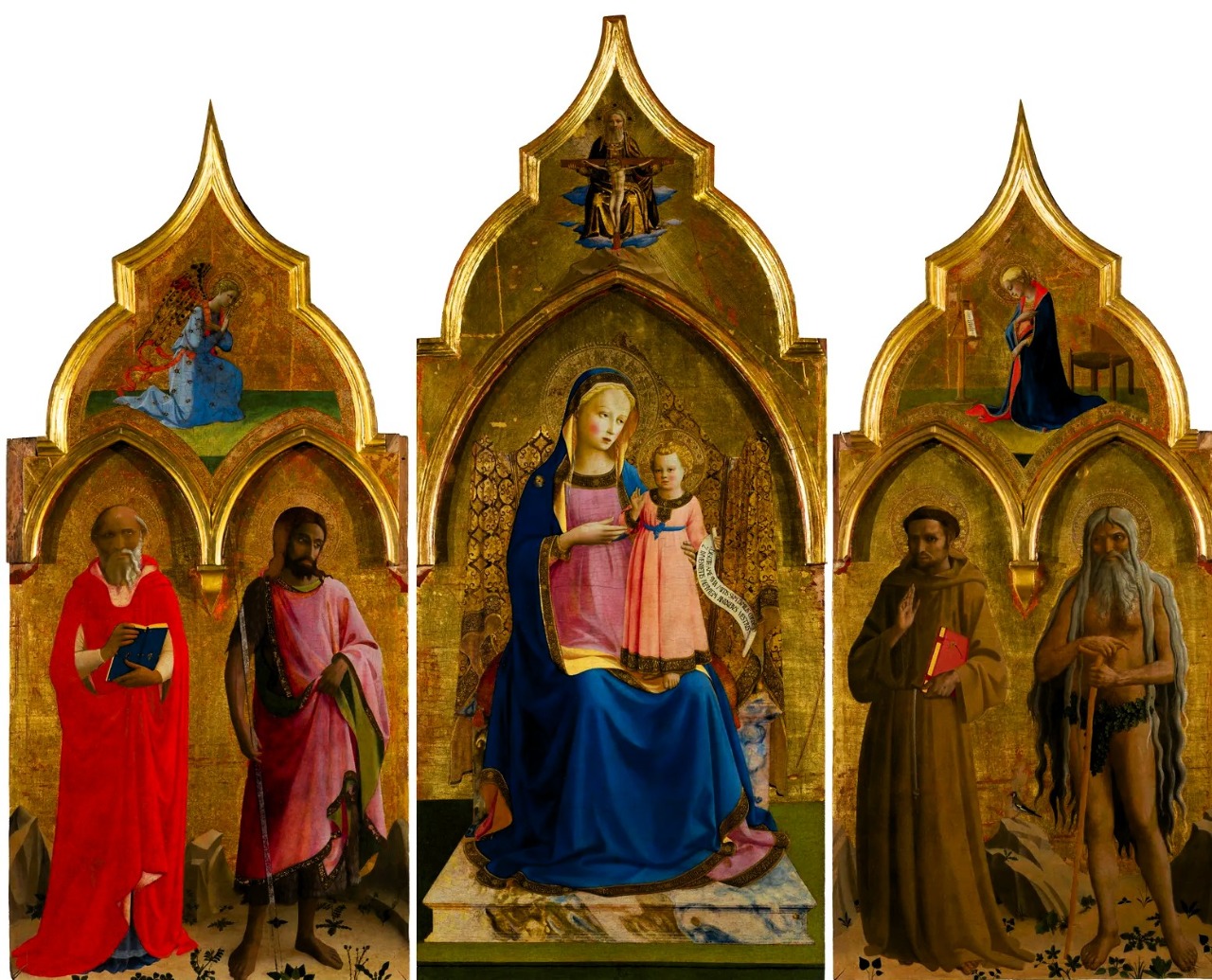
In recent years, various experts, after carefully examining the style, technique and chemical properties of the colours, have come to the conclusion that the predella paintings originally were attached below the large so-called Franciscan triptych, which is now kept in Florence’s San Marco Museum. After being restored, the altar painting was one of the main attractions of the exhibition at the Strozzi Palace, where the six predella paintings were placed under it.
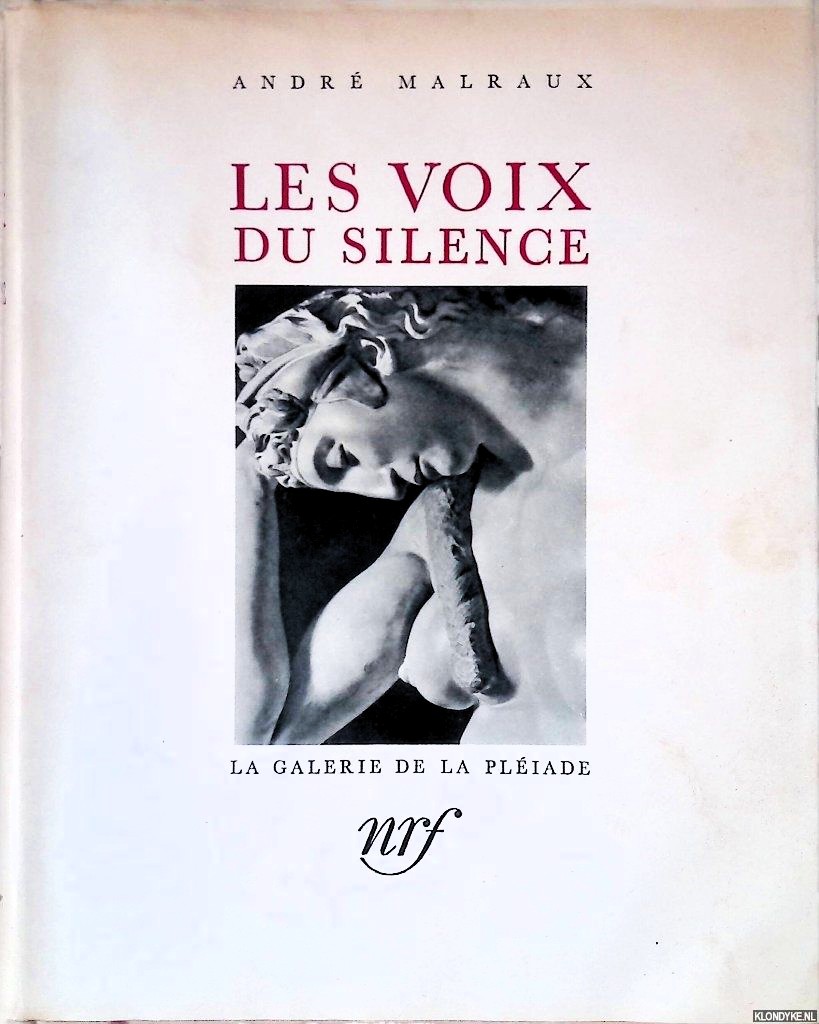
In his fascinating Voices of Silence from 1953, André Malraux presented, in a personal manner, works of art from all times and different corners of the world. The imaginative book was part of a concept he had launched in 1947 – The Museum without Walls.
Walter Benjamin had previously explained that works of art have an “aura” that could only be perceived while you were directly confronted with the original. This “aura” is lost when an artwork is reproduced, as a photograph or a copy. Malraux, on the other hand, regarded skilfully made art reproductions in the form of photographs as a kind of liberation from the confining, isolating effect of museums. Their spatial boundaries prevented an intellectual flow, while he advocated the opening up to an infinite space where the artworks could cross-pollinate each other and stimulate free associations, a space for new experiences and a source of tolerance that would change people’s common views of other cultures and their exclusive means of expression, a give and take, a democratic utopia.
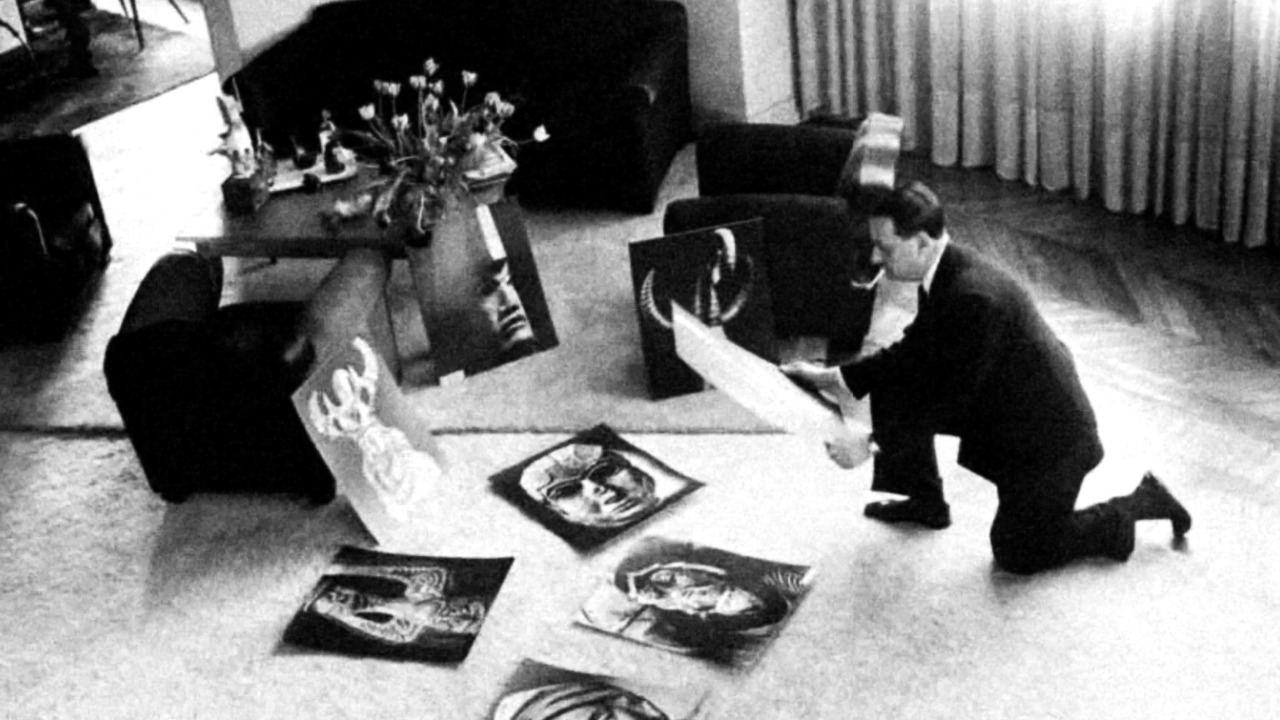
Of course Malraux is right, I love (admittedly a misused word, but in this case I am amiss of another one) to browse through my art books and I have durimg a long life acquired an impressive collection of art cards. However, to consider a reproduction of a work of art is not the same as to end up in front of the original and observe it in quiet contemplation. To be alone, freed from the crowd of tourists, yes maybe even socializing all together, and to be able sink into close contact with the artwork. Like when I saw Fra Angelico’s vision of Francis in the monks’ bare room and got to enjoy all its exquisite details. When I up close could experience the hard surface that characterizes most of the great masterpieces of early Renaissance, which furthermore have in an amazing manner preserved their clear lustre. This is a truly mystical experience that, like such experiences, defies description. Such a work of art speaks to you, and that is precisely why Malraux’s title of his book is so unusually descriptive – The Voices of Silence.